
Projects of the work.
Concrete works for the common good. What we are building: a programme for adolescents, a detoxification clinic, a vertical-farming system and Project SER, already under way.
Project SER
The model of comprehensive social reintegration for people leaving prison, people without a home, survivors of abuse and migrants is the work already in motion.
Fiat Voluntas Tua-San Agustín
In Costa Rica many adolescents face severe behavioural, emotional or mental disorders, often with addictions and difficulty integrating socially and at school. Fiat Voluntas Tua-San Agustín is the answer: a safe, structured place where young people rebuild their lives and develop their potential.
Every adolescent has a unique story and complex challenges. The aim is to accompany each one through re-education, healing and hope, with the tools needed to rejoin society with confidence and purpose. The integral approach rests on five pillars.
- Continuous psychological care: daily accompaniment by resident psychologists.
- Behavioural intervention: crisis management and emotional regulation, learning self-control skills.
- Comprehensive education and occupational workshops: academic routines and practical workshops that build discipline, social skills and confidence.
- Drug and alcohol rehabilitation: specialised programmes with professional follow-up in the physical, emotional, family and social spheres.
- Spiritual development: inspired by Saint John Paul II's encyclical Fides et Ratio, harmony between faith and reason, ethical values and personal reflection.
EME detoxification and addiction-treatment clinic
Substance use has grown in Costa Rica and specialised centres are scarce. The EME Clinic project proposes a detoxification and comprehensive-treatment clinic for 100 patients dependent on legal and illegal drugs, including alcohol, stimulants and opioids, serving San José and its surroundings with an interdisciplinary team of health professionals, occupational therapists and social workers.
Treatment is organised in five phases, and the clinic is planned with the following infrastructure and team.
- Initial assessment: clinical history, psychological and psychiatric evaluation, comprehensive diagnosis and a personal plan.
- Detoxification: continuous medical supervision, medication when needed and emotional support.
- Therapy and rehabilitation: individual cognitive-behavioural therapy, group therapy and family therapy.
- Social reintegration: job training, partnerships with companies for employment and follow-up afterwards.
- Relapse prevention: periodic consultations, coping strategies, support groups and community networks.
- 50 double rooms for 100 in-patients.
- 5 medical offices and 10 psychology offices.
- 3 group-therapy rooms and a multipurpose hall.
- Dining room for 100, industrial kitchen, gym, library and study room.
- Team: 10 specialist physicians, 15 psychologists, 10 nurses, 10 occupational therapists, 5 social workers and 10 administrative assistants.
- Estimated budget: 4.75 million US dollars (infrastructure 2.5; medical equipment 0.75; staff and annual operation 1.5).
- Planned sources: private investment, grants, donations and sponsorships, agreements with insurers and health bodies.
Green Booster Tower: self-sufficient vertical farming
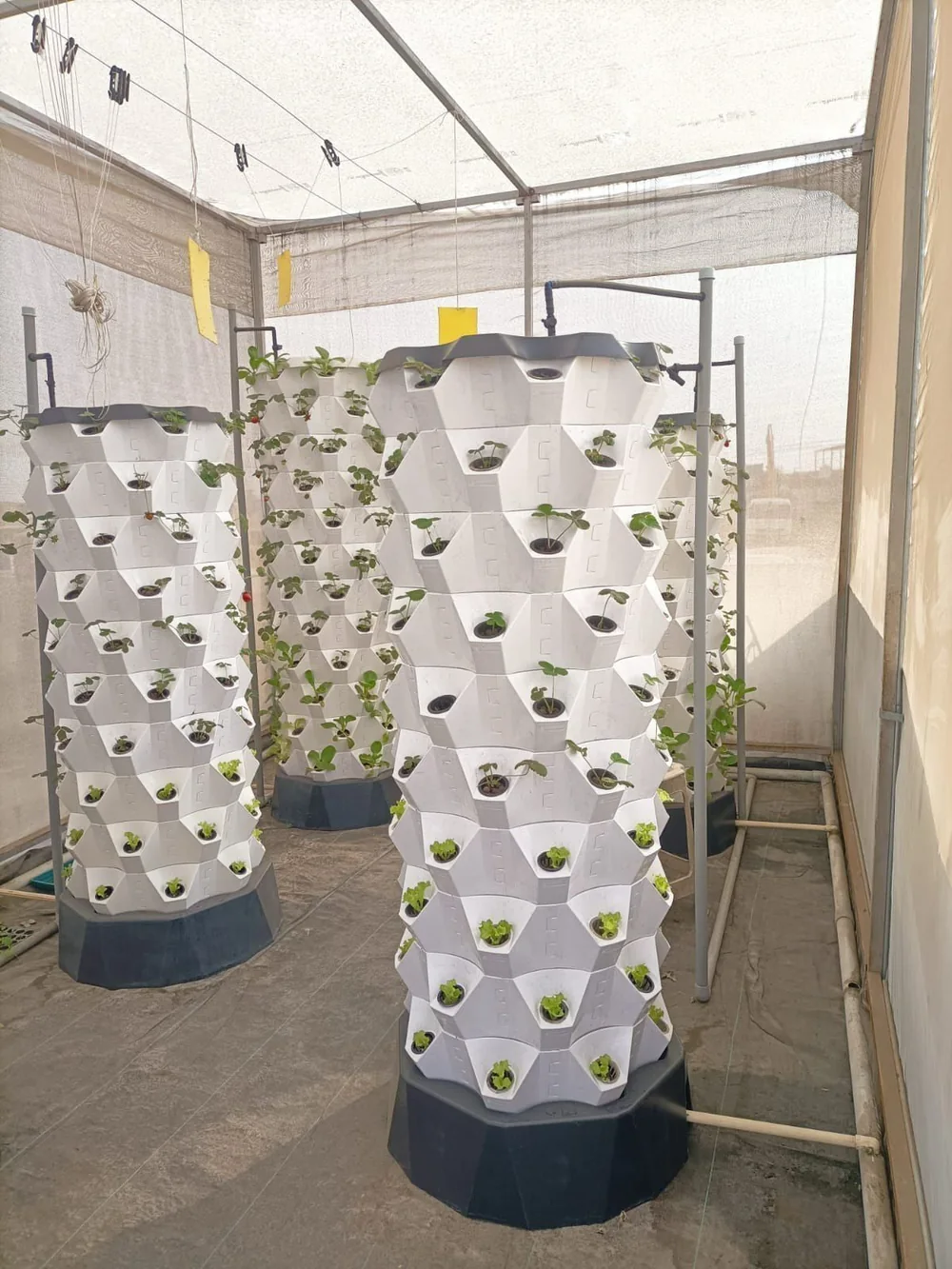
The Green Booster Tower is a vertical structure with 12, 24 or 36 growing cells. Each plant grows inside a bioactive compound: a natural allotropised seaweed fertiliser, Hydro Booster water gel that regulates the water supply, natural minerals and vitamins, coconut-husk fibre for retention and aeration, and a hydroactive polymer that keeps moisture and nutrients available in a controlled way. The seed germinates, grows and feeds according to its needs, with no constant watering or external fertilising.
It is a complete programme: the modular structure ready to install, certified organic seeds (vegetables, medicinal herbs, small fruit species, ornamentals and flowers), the allotropised fertiliser, the Hydro Booster gel and every component of the compound. Towers can be ornamental, for urban spaces; medicinal, for therapeutic crops; or food-producing, for home use or small commercial output.
Objectives: an integral ecological system of self-sufficient vertical farming; natural and renewable resources in production; food self-sufficiency in cities and the countryside; less water, fewer synthetic fertilisers and less land; a modular, scalable and sustainable model.
The technical key is the allotropisation of nutrients, which turns the seaweed's natural compounds into more assimilable molecular forms, together with a polymer that stores and releases water as each plant requires. The project supports a circular economy with recycled organic materials such as coconut, removes chemical fertilisers, creates urban green spaces and drives environmental education, community participation and income from selling or using productive towers.
Its modular, low-maintenance design allows series production and quick installation at three scales: domestic (small towers for homes or terraces), commercial (interconnected systems for urban gardens or organic-produce businesses) and educational or institutional (schools, universities and community projects).
Alliances
The work rests on an alliance between the Alimentando Esperanzas María Fortaleza foundation and Marian Apostle Mission, and on the support of P.A.C.E. L.A. O.P.U.S. for the MANAVE Group.